
Transform Work - National Food Distributor
Turning fragmented data and buyer instinct into explainable, AI-supported decisions.
- $4B+
- National food distributor serving supermarkets, foodservice companies, and restaurants
- 17,000+ Products
- Matched and validated at 99.99% accuracy to establish a trusted data foundation
- Production AI
- Machine-learning forecasts and a natural-language analytics assistant launched in 2024
- Full Handoff
- Documentation, knowledge transfer, and a platform the client’s team could operate and extend
When inventory expires, every decision has a deadline.
A national food distributor with more than $4 billion in annual revenue managed large volumes of perishable inventory across six purchasing categories. Buyers had approximately 10 days to sell fresh products before they needed to be discounted, frozen, or written down.
Purchasing decisions depended heavily on experience and instinct. The company had substantial operational data, but it was fragmented across its ERP, business-intelligence tools, and legacy systems. Important questions were answered through rigid reports, manual analysis, and individual judgment.
The business had no predictive view of demand, optimal inventory, pricing floors, or products at risk of aging.
Every incorrect assumption created real financial consequences at scale.
Turn a broad AI ambition into one valuable operating capability.
Company leadership had identified AI as an important strategic priority and assembled a long list of possible use cases.
VBT began with a focused discovery effort inside the purchasing organization. We interviewed stakeholders, mapped how decisions were made, examined the available systems and information, and tested the opportunity using real ERP data.
Together, we prioritized the questions with the greatest immediate business value:
- How much of each product should be held in each warehouse?
- What demand should buyers expect?
- Which inventory was approaching risk?
- What pricing floors would protect margin while reducing waste?
The result was a practical roadmap centered on improving one of the company’s most consequential areas of work.
AI cannot improve decisions until the underlying information can be trusted.
Before introducing forecasts or recommendations, VBT worked with the client to reconcile and validate product information across more than 17,000 items.
The resulting product-data foundation achieved 99.99% matching accuracy before launch.
This was not a measure of forecasting accuracy. It was the level of accuracy achieved when matching and validating the underlying product records required by the system.
Establishing that trusted foundation was essential. Buyers would not adopt recommendations from a system built on incomplete, duplicated, or incorrectly matched information.
Build explainable decision support around the way buyers work.
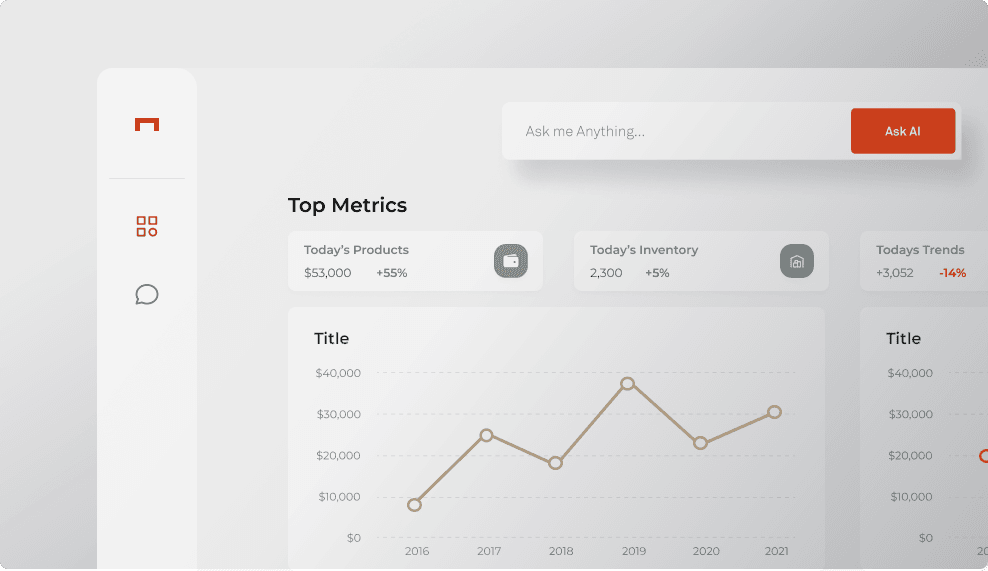
VBT designed and built a production platform combining machine-learning forecasts, operational reporting, and natural-language access to company information.
The platform included:
- Optimal inventory recommendations by product and warehouse
- Demand forecasting
- Dynamic pricing-floor guidance
- Aged-inventory alerts
- Explainable dashboards showing the information behind each recommendation
- A natural-language analytics assistant allowing authorized users to ask questions across company data
The goal was not to remove buyers from the process. It was to give them earlier signals, stronger information, and a more consistent basis for making high-value decisions.
The system combined data, predictive models, business rules, explainability, and human judgment within one operating experience.
From static reporting to production intelligence.
Within months, the client moved from rigid historical reports and manual analysis to a production system capable of forecasting demand, identifying risk, and supporting purchasing decisions.
The platform gave buyers a clearer view of what was likely to happen, why the system was making a recommendation, and where their attention was most valuable.
Just as importantly, the work established capabilities that could support additional analytics and AI use cases:
- A validated product-data foundation
- Reusable connections to core operational systems
- Explainable model outputs
- Natural-language access to business information
- A production experience designed around human decisions
This was not an isolated model or demonstration. It was a new operating capability embedded in the purchasing organization.
Build capability inside the client, not dependence on VBT.
VBT completed the engagement with detailed documentation, knowledge transfer, and a full platform handoff.
The client’s team received the information and technical foundation required to operate, maintain, and continue extending the platform.
The objective was not to create permanent reliance on an outside partner. It was to leave the organization with a production system it trusted and a stronger internal capability than it had before the engagement began.
Transformation begins when fragmented information becomes trusted action.
This engagement started with one department and one expensive operating problem.
VBT brought together the data, predictive models, business rules, explainability, and user experience required to change how purchasing decisions were made in practice.
The broader lesson applies far beyond food distribution: AI creates value when it is built around an important decision, grounded in trusted business context, and integrated into the way people actually work.
Find the next workflow worth changing.
VBT can help identify the workflow with the strongest business case, redesign how it should operate, and put the new way of working into production.